






By Cassie Honeycutt and Peyton Dickerson, Editor-in-Chief/Online EIC
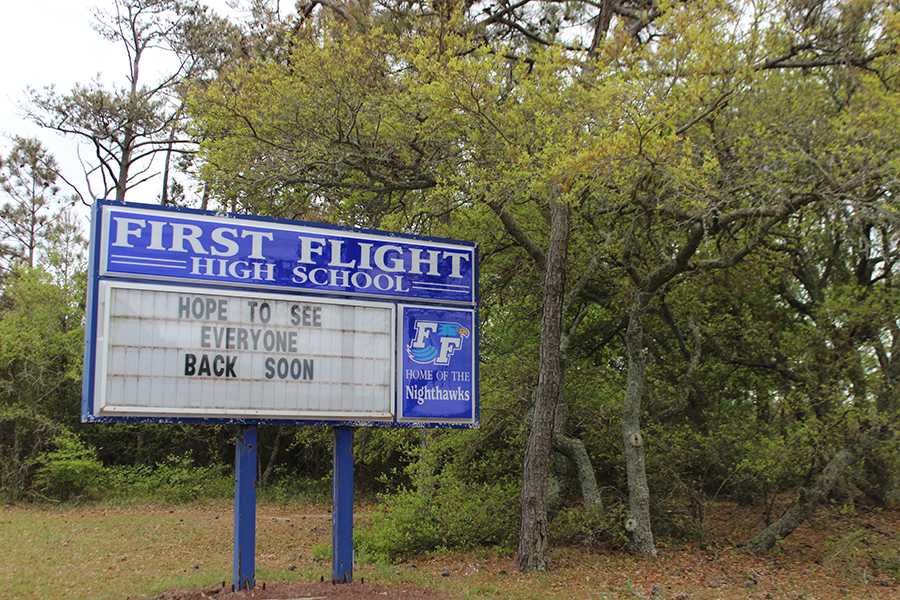
After almost three hours of discussion Thursday night, with thousands of students, parents and teachers anxiously waiting, members of the Dare County Schools Board of Education came to a unanimous decision to send students back to school on Oct. 26.
Superintendent John Farrelly presented six plans for either staying fully remote or resuming in-person instruction, which ended March 13 due to the coronavirus pandemic. Students will return to school under what has been deemed Option 2, where PreK-5 will be at school full time with no limits on social distancing, and grades 6-12 will return under a hybrid model with A/B cohorts.
“It’s an option that gets students in the building and gets face-to-face learning which, obviously, is the most effective way of teaching and learning,” Principal Chuck Lansing said. “But it also still affords students the opportunity to remain virtual if that is what is working best for them.”
With the decision made, questions still abounded from parents, students and teachers alike.
For younger kids under Option 2, Oct. 26 will be the first day for students with disabilities, PreK and grades 3-5. Then on Nov. 2, kindergarten, first- and second-graders will be integrated as well.
Grades 6-12 will return on Oct. 26 in A/B cohorts, meaning students with last names A through K will go to school Monday and Thursday and learn remotely Tuesday and Friday. Students with last names L through Z will attend school Tuesday and Friday, and will be remote Monday and Thursday. All 6-12 students will learn remotely on Wednesdays.
As Board members asked questions and discussed the pros and cons of various reopening plans with Farrelly, an emphasis was made on having students make at least a gradual shift to in-person learning for when Gov. Roy Cooper eventually allows all schools to reopen at full capacity.
“If we start now, we’re opening the door, we’re getting people back to work, we’re getting kids back to school – the journey of 1,000 miles begins with one step,” Board member Harvey Hess said at the meeting. “If we don’t take that step, we will be behind the 8-ball.”
Reaction to the decision was mixed, as students, families and teachers weigh the benefits of returning to in-person learning with the risks of catching coronavirus and disrupting the routines they’ve gotten into the past seven weeks.
“I am not excited to go back to school,” junior Jada Lancsek said. “I enjoyed online school because I was able to work at my own pace and make sure I understood everything. But hybrid is better than going back fully because I still get time of my own.”
Seniors like Grace Topping, however, are eager to return: “I’m excited to go back to school so I can get back on a routine and have a little bit of normalcy to make up for lost time of my senior year.”
Farrelly stressed in his presentation that the return to school will look different. Everyone will have to wear a mask unless they qualify for a medical exemption or are under the age of 5. Mask breaks and time outside will become part of the new school day.
“Well, (wearing a mask) could be worse,” senior Jonathon Davis said. “I’ve gotten used to wearing a mask seven hours a day from working this summer anyway.”
Social distancing will also be enforced, with new guidance stickers to help keep students six feet apart from each other. The stickers will be placed everywhere inside schools to direct students on where to exit and enter certain areas, where to walk in the halls, how many people can be in smaller spaces like bathrooms, and other situations. Class changes also will be more spread out to avoid crowding in the hallways and at lockers.
Each day, students will have to answer three health screening questions before being allowed in the building. High school students will be able to answer the questions for themselves on their phones thanks to a platform called “Healthy Roster.”
All students and staff members will have their temperatures checked as they enter the building. DCS has also invested in a thermal temperature monitoring solution – a system that will take temperatures in the morning as everyone walks in and notify administrators if a student with a high temperature is detected. This will reduce wait times in school buildings that take place with handheld temperature checks.
“Our facilities are prepared, our structures are in place. We will be effective in what we do because we’re Dare County Schools,” Farrelly said at the meeting. “There’s a lot of challenges ahead of us regardless of the model.”
One of those challenges includes reacting to positive COVID cases if and when they occur. To keep track of what’s going on with cases while students are back, DCS has partnered with the health department to create a case communications graphic.
This graphic will display school-affected cases, DCS populations, the number of new positive cases and the percentage of people on campus with the virus. Sheila Davies, Dare County Director of Health and Human Services, explained that this chart will be updated weekly and available on all DCS platforms.
With all of these safety precautions being taken into account, it’s time for students, families and teachers to assess their next step. Students who wish to keep working from home have until Oct. 8 at 5 p.m. to enroll in the Virtual Learning Academy for the remainder of first semester. Information and the application can be found here.
The Board meeting included two other key votes. Sports workouts are allowed to begin again for all DCS students on Oct. 5. The NCHSAA shifted seasons for every sport, with cross country and volleyball set to begin Nov. 4, but all athletes in Dare County now can participate in offseason workouts as scheduled by coaches.
And all students just earned a surprise fall break, as Oct. 21-23 will now be teacher work days so teachers can get into their school buildings to plan lessons and set up their classrooms for in-person, socially distanced learning. Farrelly stressed in an email to families on Friday morning that teachers would not be expected to deliver content on those three days and added that students will also not be expected to work on those three days.
“Time to start planning. Figure out the best ways to pace out lessons and make sure that our students have resources that they can take home with them,” Lansing said. “(We need to) make sure we are prepared as we can possibly be for this next piece.”
We’d love to hear your thoughts on the reopening plan! Leave a comment below. Note: All comments include a name and email address for verification, but only your screen name appears with the comment.
Senior Cassie Honeycutt can be reached at [email protected].
Senior Peyton Dickerson can be reached at [email protected].