















By Taylor Seal
Managing Editor
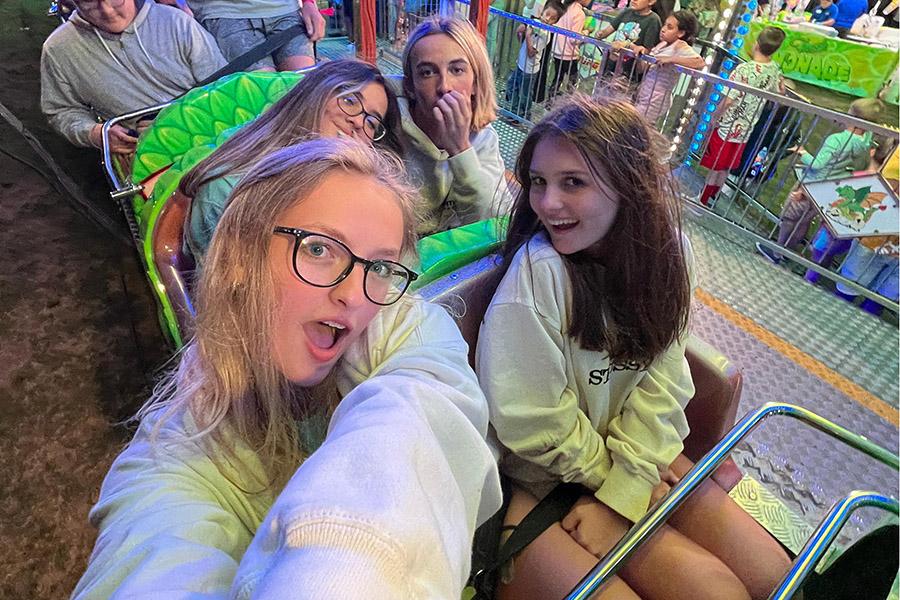
[dropcap]A[/dropcap] picture is worth a thousand words. So is a selfie. The number of selfies—pictures taken of oneself by oneself—people take usually indicates their confidence level and the way they feel about themselves, according to a Harvard psychological study.
These days, selfies are taking over social media. Millions of young adults, as well as some older individuals, have embraced the selfie and use it as a means of expressing themselves.
“I usually take selfies to entertain myself,” sophomore Heidi Jacobson said. “If my friends and I are just hanging out with nothing to do, taking awkward pictures of ourselves is usually a funny pastime.”
Sharing pictures of oneself is much more neurologically rewarding than sharing pictures of others, according to the Harvard study.
Not everyone likes pictures they see of themselves, but if they do, they are more inclined to share them on social media sites.
“I don’t usually like pictures of myself but if I do take a flattering picture, I’ll post it on Instagram,” junior Emily Lyster said.
Selfies are abundant on many different social media sites, according to NewsObserver.com.
Instagram has more than 36 million photos tagged #selfie, over 98 million tagged #me and many, many more selfies with no tag.
A word preceded by a hash or pound sign is used to identify messages on a specific topic. Social media users can search for different types of photographs based on these tags.
Adults are also starting to embrace the selfie and the hashtag. There are mixed feelings from different age groups about who should take selfies.
“I think in either case (being older or younger) it is about approval,” English teacher Hunter Will said. “It depends on where the photo is put and what the caption is. It also depends on the purpose of the photo and where a person is psychologically in their lives.”
Younger adults may not accept the photos from the older generation either.
“If you are an adult and you take selfies, it is a little more awkward than if a teenager is taking selfies,” freshman Hannah Montgomery said.
One popular venue for selfies is Snapchat, which emerged in 2012. Snapchat is a phone application that allows people to take pictures of themselves and send them to others.
“I think Snapchat accurately represents the fleeting nature of today’s communications,” junior Matthew Thibodeau said. “It is the ultimate manifestation of the insubstantiality of our modern interactions, and I see it as yet another step (toward) an anti-intellectual society. But it is great for selfies.”
Recipients can view the photo for the time allotted by the sender and then the photo disappears.
If the recipient takes a screenshot of the picture, the sender receives a notification of the occurrence.
Because the photos disappear in 10 seconds or less, it is less about looking good and more about conveying an authentic moment, according to NewsObserver.com.
“If used appropriately, Snapchat can be a fun thing among friends,” senior Drew Scott said. “But there is a lot of potential for it to be used inappropriately which could lead to negative consequences.”
Snapchat is another form of social media that allows people to share their experiences.
According to Snapchat.com, one is solely responsible for his or her user content. Snapchat is not obligated to review.
More than 80 percent of posts on social media sites are about the recent activities or personal experiences of the individual posting the information, according to the Harvard study.
“I don’t use Snapchat,” senior Emma Gilbert said. “But I have posted a selfie before and I can understand why people would want to take them.”
People share selfies and other information about themselves in hopes of receiving positive feedback.
“I might remove a selfie if it didn’t get a lot of positive feedback,” senior Alex Nolte said. “A good selfie is usually accomplished by taking several pictures from different angles and choosing the best one. I always feel better when a lot of people like my selfies.”
Relating one’s daily experiences to people through pictures or through a written status gives people joy, according to the Harvard study. Knowing that these posts are accepted emphasizes this joy.
“It is very reassuring to know that people like your pictures. I know many people who post pictures of themselves daily or weekly,” Gilbert said. “They all want the same thing that most selfie takers want, approval from peers and a chance to talk about—or in this case, show—their personal experiences.”
Send comments to [email protected]