


By Allie Nigro, Online Editor-in-Chief
Many children consider recess to be the best part of their school day. Playing tag with your friends, going down the slide and learning how to swing on the monkey bars for the first time are all vivid memories many students possess.
Though for two little girls, playing together on the playground during recess presented a daily challenge.
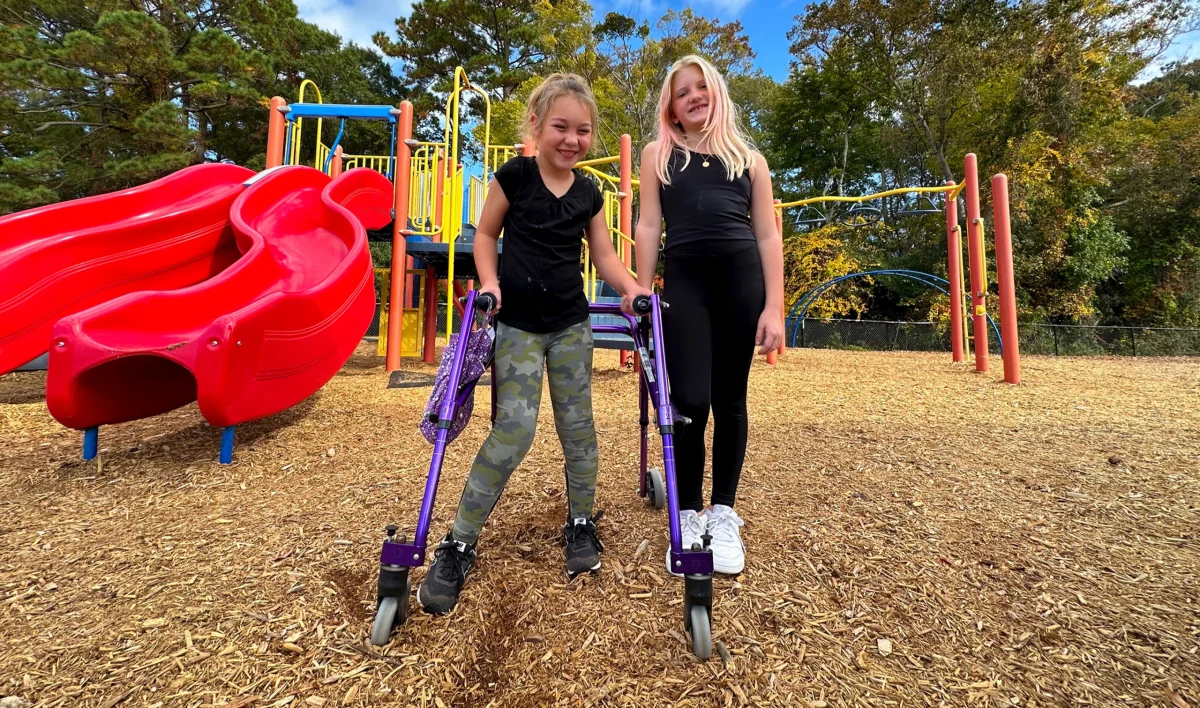
Nine-year-old Nola Flock has Cerebral Palsy, which makes moving very difficult. She now uses a walker to get around, but when going to kindergarten, she needed a wheelchair. The mulch and uneven surfaces on the Kitty Hawk Elementary School playground meant she had to sit in one spot and watch other kids play during recess.
Nola wasn’t the only one disappointed about her inability to play with other kids on the playground. Her classmate, Penny Krieg, soon realized there was a problem, too.
“Penny was disappointed that she couldn’t play with Nola because the wood chips would prohibit Nola from being able to bring her wheelchair or walker out to the playground,” said Penny’s mom, Audra Krieg. “The only place that Penny could find to be with Nola was a shade structure that sat on the back corner of the playground.”
It’s no secret that the world is designed for able-bodied people, and if you intentionally look around, it’s not hard to see how inaccessible things are for a person who uses a wheelchair or walker.
“As adults we can brainstorm ways around these challenges, but as a child on a playground it is more black and white – they simply cannot play with their friends,” said Nola’s mom, Kellie Flock.
Both Flock and Kreig worked closely with the administrators at Kitty Hawk Elementary to figure out what kind of playground could be built that would be both exciting and accessible, and before long, the KHES Playground Project was born.
“Our vision is to provide a place where individuals from our school and community can play without having to worry about physical barriers,” Principal Lisa Colvin said. “This playground plan includes surfacing so all children can play together, and a layout and ramped equipment that encourages children and adults to play together even if their physical or cognitive abilities differ.”
The surfacing of the playground was something that they thought long and hard about. In the end, shifting from inexpensive mulch to the smooth, rubbery material installed at some other parks people have visited won out.
“It is one of the most expensive parts of the project, but absolutely integral to making our playground accessible and inclusive,” Flock said.
A committee to lead the project started the task of raising funds and spreading awareness with messages to the Dare County Schools Board of Education and others in the community. The website KHESPlayground.com showcases the project – and it’s price tag of between $600,000 and $800,000.
So far, DCS has awarded $90,000 to the project and a Walmart community grant added a nice boost: “They gave our school $30,000 towards our vision of inclusivity and children of different abilities being able to communicate and play together,” Colvin said.
“Our first hurdle is raising enough money to start phase 1 of the project,” Flock explained. “That’s a little over $200,000. But ultimately we want to raise enough to complete all parts of the project as soon as possible.”
The committee is currently raising funds through grants and donations, which can be made at the playground website.
“We plan to start reaching out to local businesses and organizations to gauge their interest and hope to find that many in the community will support the project,” Flock said. “Further on, we may try to organize fundraising events to raise more interest.”
As far as Flock, Krieg and others are concerned, the project is worth the price tag, not only so Nola can play with her friends, but allow a wide variety of kids and adults who are able-bodied, mobility challenged and even those with sensory struggles such as autism to have a space to enjoy.
“I think the main reason people should donate is because everyone can benefit from this project,” Flock said. “While the playground is located at KHES and during school hours will be restricted to their students, the idea is that after school, on weekends, holidays and over the summer this will be a community playground.”
Krieg echoed similar thoughts.
“I don’t think of this playground as something for the children with disabilities, I think of this as a playground for all of the children to be able to play together,” Krieg said. “When we take away the limitations of a playground, we open up our children to understand their peers in so many more ways.”
This project is extremely important to Flock. Raising a child with special needs has forever changed her and how she views life.
“I would encourage people in our community to think about what their daily lives or the lives of their children would be like if they could not walk,” Flock said. “Look at your surroundings and see where we can make things more inclusive.”
Furthermore, Flock stressed that anyone can start a project like this.
“Anyone can do a project like this, and they should,” Flock said. “You just have to want to make a difference and then take the initiative to do it. Yes, it is an enormous amount of work and can be overwhelming and frustrating to tackle. However, it pales in comparison to the challenge of raising a child with mobility issues in a world that is so inaccessible.”
Senior Allie Nigro can be reached at [email protected].