



















By Meghan Savona, Opinions Editor
Signing your final FERPA waiver, paying the last $80 application fee, that conclusive rush of relief — college applications are over.
After all the applications have been submitted, it feels like the hard work and stress is finally over. The anxious feeling sets in because of impending decision releases and it feels like there’s nothing to do but wait. But the hard work isn’t over; you’ve applied to college, but how’re you going to pay for it? Many families find themselves in a kind of financial purgatory: they make too much money to qualify for FAFSA or need-based scholarships, but they don’t make enough money to effortlessly cover the astronomical cost of college.
It’s easy to wait until the last minute to start searching for scholarships, but the more time goes by, the more deadlines pass to apply. It may seem like there are countless scholarships that you’re eligible for, but many have numerous qualifying stipulations. Finding scholarships you’re eligible for is more than half the battle — most scholarships are actually relatively easy to apply for.
Some bigger scholarships require essays. Tackling an extra essay on top of school work can seem daunting, even if writing comes naturally for you. Finding a topic that you’re passionate about can help lessen the burden of scholarship essays. You’re not in English class — you can choose what you want to write about.
If you write an essay on a subject you’re not passionate about, it’ll be obvious. Instead of wasting your time writing numerous short essays that you’re not passionate about, find an essay prompt that you feel connected to. Writing a 200-word story on a subject you’re apathetic toward can take longer than writing a 1200-word story that you’re impassioned about. When you care about what you’re writing about, that will be transparent in your application.
Finding your niche for scholarships can be helpful. Be specific in your search: What differentiates you from other people?
It can feel like every site on your scholarship search is taking you to another site, and so on. Knowing which sites are reputable can drastically decrease your time wasted searching for fake scholarships.
Some sites will match you automatically to scholarships that you qualify for. These sites can charge a few dollars a month, but make your scholarship search dramatically easier. Instead of wasting hours clicking through Google until you’re deep into the ninth search page, it can be worth it to sign up for sites like Scholly, which personalize your scholarship results.
Sites like Unigo give the option to refine your search results. If you don’t have a natural affinity for writing, Unigo provides a filter you can select to show only scholarships that don’t require an essay. If your GPA isn’t the highest but you’re a talented writer, there’s an option to show only scholarships that require an essay, but no GPA.
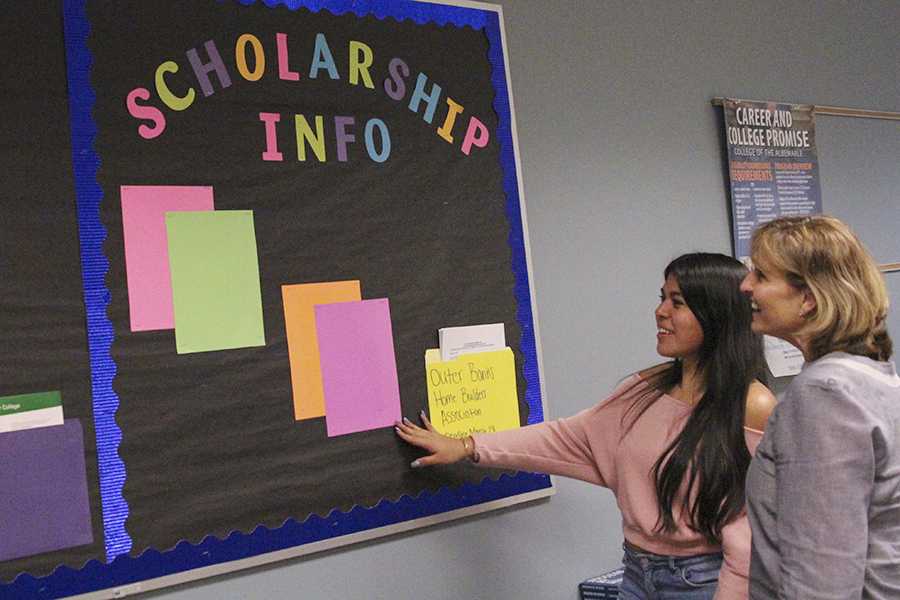
Decreasing the pool of people you’re competing against is also a good way to increase your chances of winning a scholarship. Although the prizes may not be as high, winning a few local scholarships can equal the amount of a larger, national scholarship. It’s better to win a few local scholarships than waste time applying for competitive national scholarships. Local scholarships through the Outer Banks Community Foundation are due March 25 at 11:59 p.m., with most FFHS-based scholarships due on March 28.
Senior Meghan Savona can be reached at [email protected].