








By Dair McNinch, Community Editor
Editor’s note: The student referred to as Steve in this story requested anonymity to protect his identity.
Steve was 17 when he spent his first night at the Dare County Detention Center. He wasn’t in there for rape, dodging a court date or stealing a car. He was there for a different reason.
“The first time I went to jail I was in two fights in my time there, suffered a concussion during one of them and was Tased so bad I still have the scars,” Steve described. “All in one night.”
After his friend’s car was pulled over for having a taillight out, Steve was the only person in the car selected to be searched. He claims this was done without probable cause. Nevertheless, he was found to be in possession of a misdemeanor amount of marijuana (about four grams) and some drug paraphernalia. On his court date, he was held for one night in the pre-trial holding tank at the Dare County Detention Center.
Because the charges were the first Steve had received, he was ordered to serve a one year period of supervised probation. Violations of this probation would send him in and out of jail the next year. He’s now out and off probation, but still maintains a strong feeling of trepidation toward the criminal justice system from his experiences.
“I felt like I was still in the system even when I was out and trying to do better,” Steve said. “The cops still went after all my friends and I relentlessly. It made me still feel kind of incarcerated.”
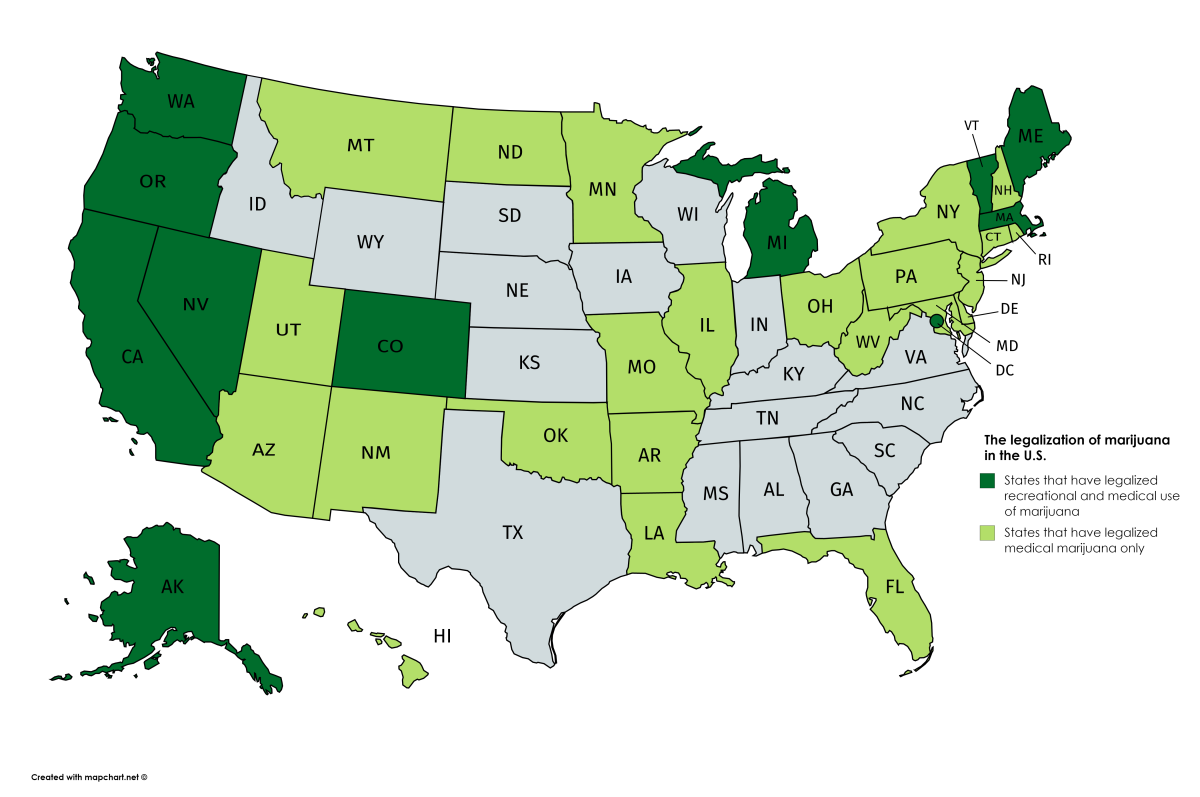
The recent midterm elections saw several small victories for marijuana legalization for adults. Michigan voted to allow recreational use, and Missouri and Utah both earned medical marijuana rights. For many other regions of the country, like the Southeast, the war on drugs still rages against marijuana. Dare County is a place tucked into one of the farthest corners of these regions. Here, the efforts against the drug are particularly evident, and change seems far from reality.
“I’d say that about 60 percent of the charges the department issues are related to marijuana,” Kitty Hawk Police Chief Joel Johnson said.
Dare County has seven fully functioning police stations with interworking divisions, Kitty Hawk being just one of the main departments. Since local law enforcement is fully equipped to protect the 300,000 or so people vacationing on the Outer Banks each week in the summer, the presence of the police can be heavily felt by the 30,000 who stick around for the other nine months of the year.
With that ratio of police officers to citizens, there’s a perception that marijuana gets more attention on the beach than in other more populated areas. North Carolina, being a consistently “red” state, has seen groups propose marijuana legalization in the past but with little hope of change.
NC District Court Judge Robert Trivette, however, mentioned one idea he believes is starting to sink in locally.
“People are realizing it’s not as dangerous as so many of these other drugs,” Trivette said.
Kevin Duprey, Captain of the Dare County Sheriff Office’s Narcotics Task Force, agreed.
“There’s a lot of other stuff that goes on, and I can only talk about it from our perspective with the drug unit,” Duprey said. “If you’re looking at someone distributing heroin or crack cocaine compared to someone distributing marijuana, our primary goal is to go after the person with the heroin or crack cocaine.”
Dare County Sheriff Doug Doughtie shared similar thoughts on the subject.
“We’re looking for harder drugs that are causing problems and killing people, whether by making them overdose or do stuff you shouldn’t do,” Doughtie said. “Marijuana isn’t where we’re going. It’s not where our effort is. We’ll take it if we can get it, but it’s not something we’re all out to get someone in trouble for.”
What becomes a topic of debate between Dare County law enforcement, though, is the amount of effort put forth into the fight against marijuana.
“I don’t think anyone discounts the fact that marijuana is still out there,” Duprey said. “We still target it, we definitely had arrests over this year and last year that were some pretty good seizures. Traffic stops are always furthering finding people smoking marijuana and finding various amounts of it.”
While the degree to which the law is enforced might have room for interpretation, penalties for those caught using marijuana in the NC court system don’t. Felonious possession of the drug is considered only 1.5 ounces in the state. Few minor marijuana charges lead to active time – something like a 45-day jail sentence – but some offenders still face the prospect of some time in the Dare County Detention Center.
“The majority of our folks are pre-trial,” Captain Allen Moran of DCDC said. “Very rarely do you see people do time for just a marijuana charge.”
Still, that’s little consolation for someone like Steve.
Like most other issues in the process of changing in the country, the debate over marijuana includes a lot of different people. There are those on either side of the law, those exploring business and scientific opportunities with the drug, and those in government digging their feet in the ground and fighting for the outcome they think is best.
Each group has an equal chance to change the situation in this state. Change is simply waiting for a choice. Trivette explained one way for this to occur:
“What it’s going to take to change is just the public’s attitude towards it. If they’re going to eventually elect their representative and tell them what they want, then there’s a chance. That’s what it’ll take, for the public to say that it needs to be legalized and that we need to stop spending tax dollars prosecuting people who are recreationally using marijuana and not harming anybody.”
Senior Dair McNinch can be reached at [email protected].